
Patient-healthcare worker interaction
Hofstede model
When it comes to culture, Ireland is very similar to the Netherlands, see https://geert-hofstede.com/ireland.html.
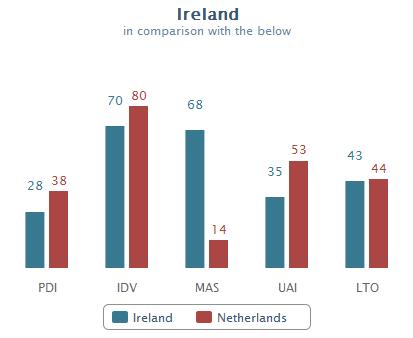
The Hofstede-model
In both Ireland and The Netherlands power distance is low, meaning that in the dietetic practice communication between Dietitian and patient is on an equal level. This means that in both countries patients prefer to have the opportunity to discuss and to shape their own diet.
Ireland is also, like the Netherlands, a very individualistic country. This means that people are free to make their own choices and to express themselves. In the dietetic practice this means you will get come into contact with patients with a variety of food preferences, like vegetarians or raw foodists, who all need an appropriate advice.
Ireland has a low score on uncertainty avoidance, even lower than the Netherlands. This means the Irish are not very concerned about controlling the future. They just let things happen. In the dietetic practice this means communication between Dietitian and patient is mainly on a social and psychological level and less on an instrumental, medical level.
There is however one major difference between the Irish and Dutch culture. Whereas the Netherlands is considered a feminine country Irish society is looked upon as masculine. This means the Irish are highly success-oriented and driven, whereas in the Netherlands it is more important that you like what you do. In the Netherlands standing out from the crowd is not admirable, whereas in Ireland people always strive to be the best.
In practice, this means that in order to get hired as a dietician in Ireland Dutch dieticians should not be too modest about their achievements. They have to compete with Irish dieticians who are used to emphasize their successes and achievements in life. It also means, in order to be taken seriously by patients, you have to underline your expertise and make clear to them what makes you the best.
Source: Hofstede, Geert